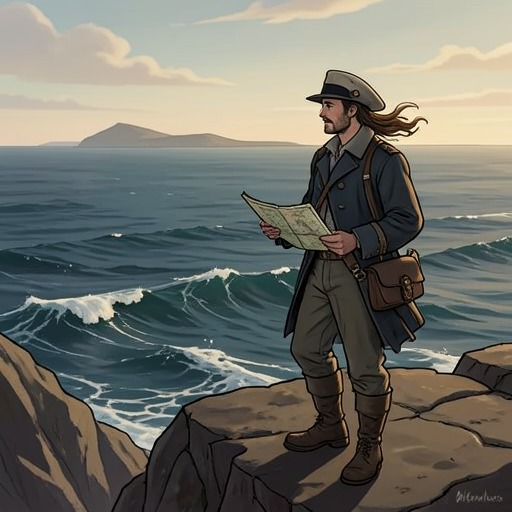
The Portuguese reach India via the Cape of Good Hope
Book of EstherThe Portuguese arrival in India by the Cape of Good Hope in 1498 marks a decisive opening of oceanic routes in the book’s account of providential history. It appears within a much larger argument: exploration made previously distant regions accessible, and the author interprets that widening of the known world as a means by which the Gospel could reach all nations.
Background and Navigational Change
The account sets the voyage against the limits of earlier navigation. Before the mariner’s compass, sailors relied on the sun and stars, and even daring navigators hesitated to venture beyond sight of land. Long voyages proceeded slowly and dangerously along coastlines. The compass, understood by the author as an application of the magnet’s tendency to point toward the poles, supplied a means of crossing open water and made routes to faraway countries practicable.
This technological change belongs to a longer story of Portuguese exploration. Prince Henry of Portugal is described as persistently advancing discovery despite obstacles; John II inherited that ambition and pursued the project with such intensity that it occupied his thoughts by day and disturbed his sleep at night. The author places their efforts within a providential account of exploration, while also identifying the desire to reach India’s riches by a new passage as one of the interests that encouraged the enterprise.
The Arrival in India
The book records the Portuguese reaching India by the passage of the Cape of Good Hope in 1498. It gives no named navigator or further particulars of the voyage, so the event is presented chiefly as a landmark in the enlargement of geographical access. The achievement is paired with another discovery of the same year: Columbus, sailing westward from Portugal in the service of Spain in search of India, had reached the American continent. His earlier voyage, in 1492, had discovered the West India Islands.
Together, these events make 1498 a turning point in the author’s account. Exploration during the fifteenth century, he argues, brought a greater advance in knowledge of the habitable world than all preceding ages. The newly opened regions included the Americas and the East Indies, which he describes as now lying open to the efforts of those seeking to circulate the Bible.
Consequences and Providential Meaning
The event’s significance in the book is not confined to navigation or commerce. The author connects the opening of overseas routes to the prediction that the Gospel would be preached among all nations. The mariner’s compass supplies a practical link in that reasoning: where the ocean had once been an effective barrier, navigation could now carry people and the Scriptures toward distant populations. The Portuguese arrival in India thus forms one episode in a wider chain of discoveries and historical changes interpreted as preparing the way for worldwide Gospel proclamation.
That interpretation belongs to the book’s broader conception of providence. Its argument treats apparently separate inventions, political ambitions, and journeys as interdependent circumstances whose combined effects advance a larger purpose. The voyage is therefore presented both as a concrete expansion of geographical reach and as one part of an unfolding process through which, in the author’s view, the Gospel could travel across the world.